
In 2026, the vast, elemental world of Teyvat has finally been unveiled in its entirety. What started as a bold declaration at the all-digital Game Developers Conference back in 2021 has now become a landmark video game milestone. MiHoYo—now globally rebranded as HoYoverse—has successfully delivered every promised nation of Genshin Impact, striking the final chord on a roadmap that captured the imagination of millions.
During that 2021 GDC talk, MiHoYo CEO Haoyu Cai outlined the studio’s grand vision for the open-world action RPG, which had already become a global phenomenon since its launch in 2020. Cai told attendees that the game’s long-term development revolved around an annual content schedule, and that the world would eventually encompass seven distinct nations, each tied to its own elemental Archon, ideal, and governing body. At the time, only two regions were fully playable—Mondstadt and Liyue—while a third, Inazuma, was poised to arrive in the upcoming 2.0 update. “We just finished the three nations out of seven, and the third one, Inazuma hasn’t been updated yet. It will take us another four years to finish all the seven nations in Teyvat,” Cai explained.
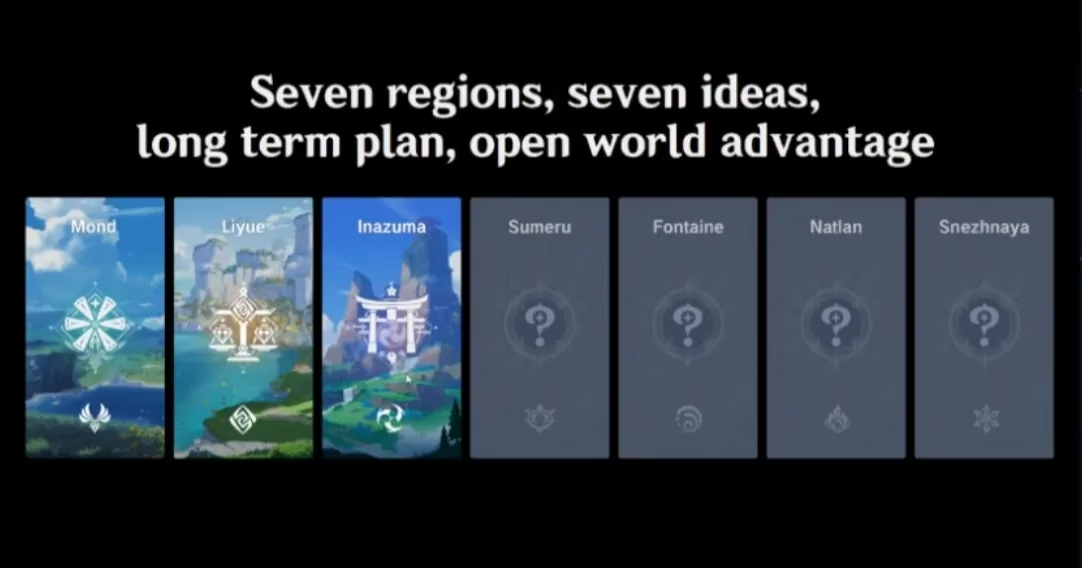
Fast-forward to 2026, and those words ring with the weight of a promise kept. The Electro-infused islands of Inazuma did indeed arrive in July 2021, introducing players to characters such as Ayaka, Yoimiya, and the wandering ronin Kazuha, alongside new mechanics like the Thunder Sojourn event and the return of Theater Mechanicus. The region’s reputation system, heavy with the ideals of eternity, encouraged a deep dive into its stormy shores and politically charged storylines. That update alone marked a turning point, proving that the developer could sustain its ambitious release cadence.
What followed was a relentless four-year march through the remaining nations. In 2022, Sumeru brought the Dendro element and a lush rainforest intertwined with a sprawling desert, while its Archon quest explored the nature of wisdom and dreams. Fontaine arrived in 2023, drenching players in Hydro-fueled justice and underwater exploration that reshaped traversal forever. The year 2024 delivered Natlan, the Pyro nation alive with tribal warfare and volcanic landscapes, pushing combat and traversal to fiery new extremes. Finally, in late 2025, the Cryo domain of Snezhnaya closed the loop. Its icy palaces, the Fatui’s seat of power, and the long-awaited confrontation with the Tsaritsa delivered a narrative finale that paid off years of world-building. By the time the first banners of 2026 rolled out, every pixel of the Teyvat map was open for exploration—a seamless continent stitched together from four years of disciplined annual updates.
The impact of this completed journey is hard to overstate. Genshin Impact’s original IGN review awarded it a 9 out of 10, calling it an “incredible open-world and addictive exploration makes Genshin Impact anime-zing adventure.” That sentiment has only magnified as the world doubled, then tripled in size. Early experiments with crossovers, such as the limited-time addition of Aloy from Horizon Zero Dawn in 2021, set the stage for a decade of collaborations that continue to inject fresh energy into Teyvat. Today, the game stands not just as a commercial titan but as a living example of how a live-service title can evolve year after year without losing the spark of discovery.
Throughout the four-year expansion, each nation retained its own identity. Mondstadt’s wind-swept freedom, Liyue’s contract-bound commerce, Inazuma’s isolated eternity, Sumeru’s quest for knowledge, Fontaine’s theatrical justice, Natlan’s fiery resurrection, and Snezhnaya’s icy resolve—every Archon and their ideals carved a distinct flavor into the game. The reputation systems that arrived with each city nudged players to complete quests, bounties, and exploration goals, creating a rhythm that turned casual logins into weeks-long obsessions.
Perhaps most impressive is how the developer managed to meet its self-imposed deadline without compromising quality. While many live-service projects stumble over scope creep or delay-ridden timelines, HoYoverse’s annual agenda became a reliable anchor. Events like Lantern Rite, Windblume, and Summer Fantasia evolved from simple festivals into elaborate story arcs, while new characters, weapons, and artifacts perpetually refreshed the meta. The gradual unlocking of Teyvat’s seven nations turned the game into a digital travelogue—one that invited players to grow alongside the ever-expanding world.
Now, with the map fully realized, attention turns to what lies beyond the seven nations. Longtime players look toward Celestia, the Abyss, and the deeper secrets of the Teyvat story that still linger unanswered. The four-year promise has been fulfilled, but Genshin Impact’s journey shows no signs of ending. If the last half-decade has taught us anything, it’s that when a vision is paired with disciplined execution, a virtual world can become a second home for a global community. And for those who stood at the statue in Mondstadt back in 2020, the completed map in 2026 feels less like the end and more like the final page of a chapter in an ever-unfolding saga.
Comments