
As a devoted Yae Miko main since her debut, I still vividly recall the storm that erupted with Version 2.6 back in March 2022. I had spent countless hours perfecting my rotation with her Sesshou Sakura turrets, relishing the way they autonomously zapped enemies across the battlefield, weaving Electro into every Elemental Reaction imaginable. When HoYoverse announced a “targeting logic overhaul,” I felt a flicker of hope—finally, I thought, her clunky auto-aim might become more predictable. Instead, the community and I were plunged into one of Genshin Impact’s most intense character controversies, a saga that would ultimately teach both players and developers invaluable lessons about trust, transparency, and the delicate art of balancing a gacha game.
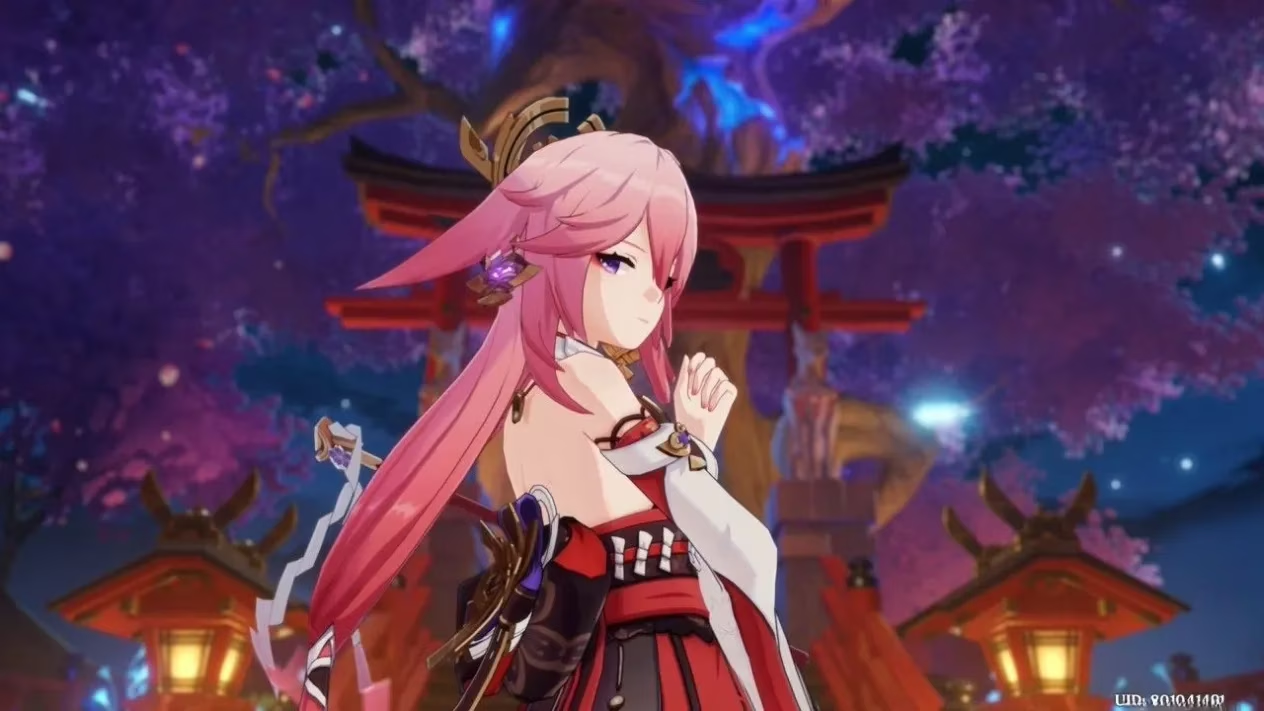
Yae Miko, the elegant and cunning Guuji of the Grand Narukami Shrine, had been a fan favorite long before her playable release in Version 2.5. Voiced by the legendary Ayane Sakura and steeped in the myth of Tamamo-no-Mae, she captivated players with her fox-eared charm, teasing demeanor, and formidable Electro prowess. Her kit, built around deploying up to three Sesshou Sakura totems that automatically strike foes, felt like a tactical delight—if you could manage their erratic targeting. The community quickly nicknamed her playstyle “afk queen,” and I delighted in coupling her with characters like Kokomi and Fischl to trigger endless Electro-Charged and Overloaded reactions. Yet beneath that smooth surface, real frustrations simmered: her normal attack sequence was painstakingly slow, and her Skill, while powerful, often hit the wrong enemy in a dense crowd.
On March 31, 2022, HoYoverse dropped a statement that addressed the very issue I had grumbled about on social media. They acknowledged that it was “hard to predict which enemy will be targeted by Yae Miko” and announced a brand-new targeting logic: her Sesshou Sakura would now prioritize the closest enemy to Yae. The reasoning sounded plausible. By simplifying the behavior, players could presumably control her damage better—just position herself near the desired target, and the turrets would obey. I remember my first thought: “Finally, some agency!” But as I logged into the game after the update, reality hit like a Ruin Hunter’s missile.
The change turned Yae Miko’s gameplay upside down, and not in a good way. In the previous version, although the turrets’ selection felt random, it actually followed an internal heuristic that spread Electro across multiple enemies. That scattering of Electro was exactly what made her so valuable as an off-field sub-DPS. With the “closest enemy” rule, her Sesshou Sakura tunnel-visioned onto whatever monster was nearest. If that enemy happened to be a shielded Hilichurl, an Electro-immune Slime, or even a Mitachurl with a wooden shield, Yae’s turrets became glorified paperweights. Instead of enabling reactions across the whole arena, they concentrated all their damage onto a single, often inappropriate target, crushing her overall DPS.
What truly ignited the firestorm, however, was the impact on Yae’s Constellations. Pulling a duplicate 5-star character in Genshin is a moment of euphoria, made possible only through months of saving Primogems or a wallet-crippling swiping session. Her C2, colloquially called “Second Constellation,” expanded the range of her Sesshou Sakura dramatically, allowing her to cover a vast area. In the old targeting logic, that extra reach meant she could tag enemies all around the battlefield with Electro, setting up reactions from every direction. But with the new “closest enemy” rule, that increased range became functionally meaningless—why bother hitting more distant foes if the turrets always fixated on whatever stood right beside Yae? Thousands of players who had spent real money to enhance her range felt robbed. The anger spilled across Reddit, Twitter, and HoYoLAB. “I saved for months to C2 her and now it’s a dead stat,” was a common lament. Japanese fans, where Yae’s popularity scored through the roof, voiced similar outrage, with outlets like Inside reporting extensively on the controversy.
I spent many evenings reading the official feedback threads and watching content creators dissect the patch notes. The consensus was clear: while HoYoverse framed the adjustment as a quality-of-life improvement, the community recognized it as a substantial nerf, one that made the character less versatile and less satisfying to play. In a gacha ecosystem where characters represent significant financial and emotional investment, post-release nerfs are virtually taboo. Even if the developers could argue it wasn’t a direct numerical downgrade, the practical effect on her performance resonated as a betrayal. My own testing confirmed the pain—I could no longer comfortably run Yae in my favorite Overload team because she kept attacking the wrong enemy, shattering my elemental setups.
The backlash was so immediate and deafening that HoYoverse backtracked within days. On April 6, 2022, a hotfix reverted the targeting behavior to its original random logic, with a promise to continue monitoring feedback and consider a more comprehensive targeting overhaul in the future. The rollback was a testament to the power of the player base, but it also left a lingering question: how could such a divisive change reach the live servers in the first place? Looking back from 2026, it’s clear that this incident served as a pivotal moment for Genshin Impact’s development philosophy. Post-2.6, HoYoverse became markedly more cautious about modifying released characters, opting for buffs rather than controversial reworks. The entire targeting system did eventually receive a reconstructed framework in 3.0, one that allowed smarter prioritization without sacrificing area coverage—an evolution that directly benefited characters like Yae, Fischl, and later, Dehya.
The real irony, though, unfolded when Sumeru introduced Dendro in Version 3.0. Yae Miko’s “random” turret targeting, which had been preserved, suddenly became her greatest asset. Spread and Aggravate reactions thrive on repeated Electro application across multiple enemies. Her ability to blanket a room with lightning, hitting foes unpredictably, made her a cornerstone of Quicken teams alongside Nahida and Fischl. Today, in 2026, Yae Miko remains a top-tier off-field DPS, a staple in Spiral Abyss speedruns, and a beloved character in lore-heavy events. Had the “closest enemy” logic persisted, her viability in the Dendro meta might have been severely crippled.
This whole saga taught me, as a player, to never underestimate the importance of collective feedback. It also reminded me that developer intentions, however well-meaning, don’t always align with the community’s lived experience. When I look at newer characters like Xbalanque or the recently buffed Shenhe, I see a design philosophy that carefully considers multiple team archetypes and avoids radical post-release kit changes. The Yae Miko targeting incident stands as a cautionary tale in gacha history, proving that sometimes, the best optimization is the one that trusts players to master the chaos rather than taming it for them.
Genshin Impact has come a long way since the days of Version 2.6, with Version 6.0 on the horizon, and the memory of that fleeting yet fierce nerf still echoes in every patch note’s comment section. Yet, it’s also a story with a happy ending—a fox lady who weathered the storm and emerged even more cherished, both as a character and as a symbol of a community that fought to keep her wild, unpredictable charm alive.
Comments